Planetary observation requires steady optics, clear light transmission, and simple alignment. The following selections cover budget-friendly refractors, computerised models, and portable travel telescopes that excel at showing Moon details, planetary belts, and distant worlds. Each option focuses on ease of use for beginners while offering features that seasoned observers appreciate. Read on to compare capabilities, portability, and accessories that help you capture or share planetary views.
| Product | Brand | Key Feature |
|---|---|---|
| Telescopes for Adults Astronomy, 80mm Aperture 600mm Refractor | EACONN | 80mm aperture, portable travel kit, two eyepieces |
| Celestron 11069 NexStar 8SE | Celestron | GoTo computerised tracking, 8-inch optics |
| Telescope for Adults Beginners, 70mm Aperture 400mm | EACONN | 70mm aperture, handy phone adapter |
| Telescopes for Adults Astronomy, 80mm Aperture 900mm | SOLOMARK | 80mm aperture, robust azimuth gimbal |
| Astronomy Telescope for Adults & Beginners – 90mm Aperture | NACATIN | 90mm aperture, solid tripod, phone adapter |
The UK market offers a range of planetary-friendly telescopes, from compact refractors ideal for kids and beginners to larger, computerised systems for more detailed planetary imaging. When evaluating options, consider aperture, stability, ease of setup, and whether a GoTo or phone adapter helps you locate planets faster. The products below were selected for their balance of optical quality, portability, and practical accessories that support observing planets such as Mars, Jupiter, Saturn, and the Moon. Each entry explains why its design suits planetary viewing and what users can expect in real-world sessions.
Compact 80mm Refractor For Beginners

The EACONN 80mm aperture refractor is designed for portability and straightforward use. With a true 80mm opening, the telescope captures more light than smaller models, delivering brighter planetary views and crisp lunar details. A coated optics glass lens enhances transmission, reducing stray reflections for clearer images. The setup includes rough adjustment and a positioning gimbal with a scale, making it easier to aim at planets high in the night sky. Two eyepieces (20mm and 9mm) offer 30x–66x magnification, suitable for tracking planetary surfaces and observing lunar features. A mobile phone adapter supports quick astrophotography or sharing observations.
Why it suits planet viewing: The larger aperture improves light gathering, aiding the visibility of distant planets and fine surface details. The adjustable mount helps you track objects as the sky rotates, while the included accessories support both visual observation and basic imaging.
GoTo 8Se Computerised Telescope

The Celestron NexStar 8SE combines a classic Schmidt-Cassegrain design with a modern GoTo computerised mount. The 8-inch aperture provides robust light gathering for planetary detail, while the GoTo system can locate and track thousands of celestial objects, including the Moon and bright planets. This configuration is designed for users who want efficient planet viewing without manual star-hopping. The mount stores a large object database and automatically aligns, enabling smoother sessions in UK skies, where light pollution can be a factor. It also supports optional astroimaging workflows for those who want to capture planetary transits or lunar phases.
Why it suits planet viewing: Large aperture and automated object locating dramatically reduce hunt time, letting you spend more time observing planes of Jupiter or Saturn’s belts and Moon craters with stable tracking across sessions.
Portable 70mm Refractor For Beginners
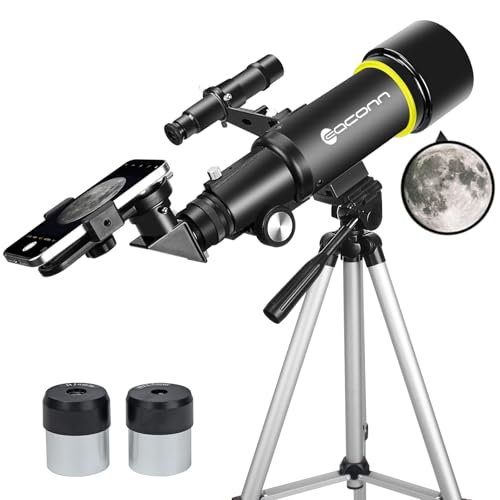
The EACONN 70mm refractor focuses on compact performance with a 400mm focal length. Fully coated optics deliver crisp images, while the 70mm aperture balances portability with light gathering for planetary viewing. The telescope ships with two eyepieces (12.5mm and 20mm), offering 20x to 32x magnification, which is well-suited for observing lunar features, bright planets, and terrestrial scenery. A 5×24 finder helps locate objects in the night sky, and a dedicated phone adapter enables quick photo captures and sharing of planetary moments, making it ideal for beginners who want fast results without complex setup.
Why it suits planet viewing: The combination of a light, travel-friendly form factor and practical magnification options supports relaxed, frequent planetary observing sessions, especially for newcomers exploring how Mars and Jupiter appear through different eyepieces.
80mm 900mm Refractor With Travel Kit

The SOLOMARK 80mm aperture with a 900mm focal length is designed for a stable, travel-friendly setup. A robust aluminum tripod and a smooth azimuth gimbal help you point and track planets with minimal tremor, while a multi-eyepiece configuration provides 90x and 45x magnifications for close lunar and planetary details. The telescope package emphasizes portability, including a carrying bag for easy transport between observing sites. It targets enthusiasts who want a capable, all-around scope that remains practical for weekend stargazing or classroom demonstrations.
Why it suits planet viewing: The combination of high magnification options and sturdy mounting supports detailed views of planetary surfaces, including Saturn’s rings and Jupiter’s bands, with reliable stability during longer viewing sessions.
90mm Aperture Refractor With Tripod

The NACATIN 90mm refractor offers a more substantial aperture for planetary viewing, with 32x–240x magnification through its 90mm objective. The iron tripod provides stability and minimizes vibrations, while the precision AZ mount allows smooth tracking across the sky as planets move. A smartphone adapter supports basic astrophotography, making it possible to capture and share moments such as Saturn’s rings or Jupiter’s cloud bands. This model balances light gathering, clarity, and ease of use for both beginners and more serious planetary observers.
Why it suits planet viewing: The larger aperture enhances contrast and reveals finer planetary features, while the sturdy base and mount help maintain steady views over longer sessions, which is valuable when chasing a clear peek at distant planets.
Buying Guide: Key Purchase Considerations For Planetary Viewing
- Aperture size and light transmission: Bigger apertures improve light collection and reveal finer details on planets and the Moon. For planetary work, an 80–90mm refractor is a solid starting point, while 100mm+ offers more detail at higher magnifications.
- Magnification and eyepieces: A range of 20x–200x is common. Ensure your package includes high-quality eyepieces and a finderscope; use higher magnifications for moon and planetary details only when the atmosphere is steady.
- Mount stability and tracking: For planets, a stable mount reduces image shake. GoTo or computerised mounts help locate objects quickly, but a solid alt-az or equatorial mount is important for smooth tracking during longer viewing sessions.
- Portability and setup: Beginners benefit from lightweight, easy-to-assemble models with included backpacks or carry cases. Travel telescopes bring flexibility to dark-sky sites and family viewing nights.
- Phone adapters and imaging: If you want to capture planetary moments, ensure a reliable smartphone or camera adapter is included or compatible with your device.
- Accessories and upgrade paths: Look for kits with included tripods, finder scopes, and additional eyepieces. Consider future upgrades like larger apertures or Q- or GoTo-mount options as skills grow.
- Build quality and optics: Fully coated lenses and good-quality glass improve contrast and color accuracy. Check refractor models for minimal chromatic aberration to avoid blurry planetary margins.
- Viewing conditions: In the UK, light pollution can affect planetary visibility. Plan observing sessions on clear nights, use light pollution filters if available, and consider a portable setup to reach darker sites.