Elevate indoor cycling with smart bike trainers that connect to Zwift and other training apps. The best models offer interactive resistance, realistic road feel, quiet operation, and easy compatibility with a range of bikes. This guide highlights top options, their standout features, and practical buying tips to help UK riders choose a trainer that complements your cycling goals and space.
| Product | Brand | Key Benefit | Link |
|---|---|---|---|
| Saris Fluid² Smart Kit Wheel On Turbo Trainer | Saris | Realistic road feel with precision flywheel | |
| Sportneer Turbo Trainer (Magnetic) | Sportneer | Stable, quiet, with adjustable resistance | |
| Sportneer Turbo Trainer (Fluid) | Sportneer | Quiet spinning, durable steel frame | |
| CYCPLUS R200 Smart Indoor Bike Trainer | CYCPLUS | High power output with uphill/downhill sim | |
| ThinkRider X2Max Smart Trainer | ThinkRider | 18% tilt simulation with dual BLE/ANT+ |
The following five products are among the most relevant for a UK audience seeking a reliable, engaging, and tech-forward indoor cycling experience. Each entry includes a concise product heading, an image, a summary of features, and practical notes to help you compare options quickly.
Saris Fluid² Smart Kit Turbo Trainer

The Saris Fluid² Smart Kit Wheel On Turbo Trainer is designed to fit common road and mountain bikes with included steel quick release skewer and three rear dropout spacing options: 120mm, 130mm, and 135mm. It features a large precision-balanced flywheel and a patented fan design to deliver a realistic ride feel. The unit supports virtual training platforms like Zwift with a speed sensor, making it easy to connect to popular cycling apps. This trainer offers a straightforward setup and a robust build suitable for varied training programs.
Sportneer Turbo Magnetic Trainer

This magnetic trainer from Sportneer provides a stable base with five adjustable anti-slip feet to level uneven floors, making it suitable for diverse spaces. It features a bar-mounted remote for six resistance settings, enabling riders to simulate varying cycling conditions. It is designed for quiet operation, though noise levels depend on tire type and flooring. The magnetic resistance mechanism offers a cost-effective route to structured indoor workouts without needing power draw or complex sensors.
Sportneer Fluid Indoor Bike Trainer

The Sportneer Fluid trainer uses a fluid resistance wheel to provide smooth, silent spinning suitable for indoor workouts. It accommodates bikes ranging from 26 to 29 inches, including 700C wheels, so many road and mountain bikes can be used without purchasing a separate frame. Durability is emphasised with a heavy-duty stainless steel frame, aiming to deliver long-term reliability. Trainers of this type generally offer more progressive resistance compared with basic magnetic units and are compatible with home gym setups where noise levels matter.
CYCPLUS R200 Smart Indoor Trainer
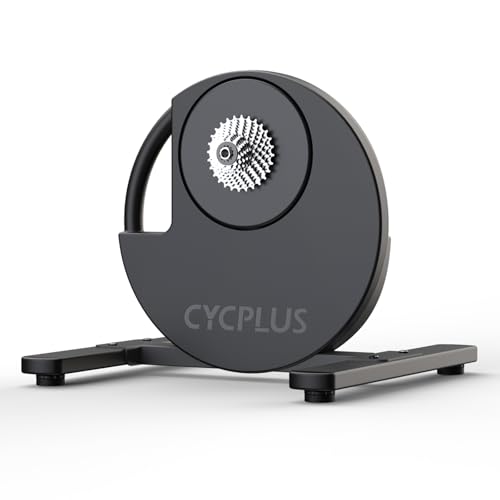
The CYCPLUS R200 offers dual-mode BLE/ANT+ connectivity for compatibility with Zwift and other cycling apps. It features an 80 Nm maximum torque and up to 2200W peak power, with power meter accuracy of ±1%. The trainer delivers intelligent uphill/downhill simulation with up to 19% incline resistance that automatically syncs with riding software for realistic gradients. Suitable for serious indoor training, the R200 emphasizes precision, responsiveness, and integration with virtual environments.
ThinkRider X2Max Smart Trainer

The ThinkRider X2Max supports both BLE and ANT+ dual-mode protocols, ensuring compatibility with major software such as Zwift. It provides up to 2000W power output with a DEPT dynamic electromagnetic torque power meter, targeting power accuracy within ±2%. An 18% tilt resistance simulates real map gradients when connected to compatible training platforms, enhancing the sensation of climbing and descending on virtual routes. The unit aims to balance quiet operation with strong resistance and realism.
Buying a smart bike trainer involves weighing several factors: compatibility with your bike (wheel size, dropout spacing, through-axle options), steering and mounting systems, noise levels, and the extent of virtual integration. Heavy-duty frames often offer greater stability for sprinting and high-resistance sessions. Some riders prioritise realistic road feel and progressive resistance (fluid or eddy-current designs), while others seek budget-friendly magnetic setups with straightforward app compatibility. Consider desk space, matting or flooring protection, and the availability of spare parts and replacement parts in the UK. If you ride in multi-user households, noise profiles and vibration isolation become important. Finally, confirm app ecosystem compatibility (Zwift, MyWhoosh, TrainerRoad) and ensure your preferred devices (phone, tablet, computer) can connect reliably through BLE or ANT+.
Buying Guide
- Bike compatibility: Check wheelbase options, dropout spacing (120/130/135mm), and whether the trainer accommodates road and mountain bikes or through-axle setups.
- Resistance type: Magnetic, fluid, or Eddy Current designs offer different progressions and noise levels. Fluid and eddy-current systems typically feel more natural but may be pricier.
- Power and accuracy: For serious training, look for higher torque (e.g., 80 Nm) and power output with ±1–2% accuracy to track improvements accurately.
- Connectivity: Ensure BLE/ANT+ compatibility with your preferred apps (Zwift, MyWhoosh, Rouvye, etc.). Dual-mode devices ease pairing across platforms.
- Noise and stability: A wide base, anti-slip feet, and robust frame reduce movement and floor impact. Consider using a mat in shared spaces for comfort and noise control.
- Portability and storage: Lightweight, foldable units or those with travel-friendly designs suit travellers or limited spaces.
- App features: Look for live ride feel, virtual routes, interactive training programs, and firmware update support from manufacturers or app partners.
- Maintenance and parts: Availability of spare parts (rollers, adaptors, skewers) and ease of servicing in the UK market.
In summary, the best smart bike trainer for you depends on how realistic you want the ride to feel, how much you value app integration, and how much space you can allocate. For enthusiasts seeking robust, realistic resistance and broad app compatibility, fluid or eddy-current trainers typically deliver superior feedback. Magnetic models offer affordability and simplicity, while high-end options emphasize accurate power data and extensive virtual environments. Evaluate space, bike compatibility, and your preferred training apps to select a trainer that will keep you motivated through the UK seasons.