Choosing the right mitre saw blade can dramatically improve cut quality, finish, and overall project efficiency. This guide highlights top-performing blades available on Amazon UK, focusing on durability, cut finish, and compatibility with common mitre saws. The selected blades cover a range of diameters, tooth counts, and materials to suit softwood, hardwood, plywood, MDF, and specialty panels. Read on to compare options and identify the best blade for your woodworking needs.
| Product | Diameter | Teeth | Bore | Main Strength |
|---|---|---|---|---|
| Saxton TCT Circular Wood Mitre Saw Blade (210mm, 80T) | 210 mm | 80 | 25.4 mm | Excellent wear resistance; versatile across softwood to laminates |
| Trend Wood Mitre Saw Blade (216mm, 60T) | 216 mm | 60 | 30 mm | Smooth, controlled cross and along-grain cuts; ATB negative hook |
| Trend Wood Mitre Saw Blade (216mm, 48T) | 216 mm | 48 | 30 mm | Fine finish; versatile for cabinetry and flooring |
| Saxton TCT Circular Fine Cutting Blade (210mm, 100T) | 210 mm | 100 | 30 mm | Very clean edge; reduced chipping on delicate surfaces |
| Saxton TCT Circular Wood Mitre Blade (255mm, 60T) | 255 mm | 60 | 25.4 mm | Balanced for heftier cuts in Evolution Rage Saws |
These selections balance feed speed, edge quality, blade life, and cross-cut clarity, helping you achieve precise mitre joints and repeatable results across common woodworking tasks.
Saxton TCT Circular Wood Blade 210mm 80T

Dimensions: 210 mm diameter; 80 teeth; 25.4 mm bore; 2.6 mm kerf. This blade is designed for along-the-grain and cross-cutting on softwood, hardwood, plywood, chipboard, MDF, and laminated panels, plus reinforced plastics. The blade body is fully hardened steel to resist bending and deflection, delivering true cuts. Tungsten carbide teeth provide wear and heat resistance, with a positive cutting angle that promotes fast chip removal. Ideal for fast, accurate mitre work with Evolution Rage Saws and similar platforms.
Features provide dependable performance for a wide spectrum of materials, including multi-board panels and fibre-reinforced plastics. The combination of high tooth count on a 210 mm blade yields a refined edge with reduced tear-out in softer stocks, while maintaining effective material removal on hardwoods where applicable. For hobbyists and professional settings, this blade supports reliable repeatability across repeated mitre cuts without excessive blade wear.
Trend 216mm 60T Mitre Blade

Diameter 216 mm with a 30 mm bore and 60 teeth, featuring a 2.6 mm kerf and a -5° hook. This blade is designed for versatile cutting performance across softwood, hardwood, plywood, MDF, and hardboard, delivering smooth and precise results for furniture, cabinetry, flooring, and general joinery. The ATB tooth form paired with a negative hook angle minimizes tear-out while maintaining efficient chip removal. It is a high-performance replacement blade that fits a broad range of mitre saw models and enables clean, accurate mitre and cross cuts.
Key advantages include reliable finish quality on end grains and panel edges, alongside compatibility with most common mitre saws. The blade’s geometry supports consistent results through repeated cuts, making it suitable for production or hobby projects where precision matters. Regular inspection for tooth wear will help maintain optimal performance over time.
Trend 216mm 48T Mitre Blade

Diameter 216 mm; 30 mm bore; 48 teeth; 2.6 mm kerf; -5° hook. This blade is oriented for a fine finish across a variety of woods and panels, delivering smooth cuts suitable for cabinetry, flooring, and furniture components. The ATB tooth form minimizes tear-out while providing solid cutting action, and it remains compatible with many mitre saw models for straightforward setup. The blade’s design emphasizes edge quality and consistency, which is valuable for projects that require tight tolerances and clean edges.
With 48 teeth, this blade is a practical choice when a balance is needed between aggressive material removal and a refined finish. Suitable for repeated cross cuts and mitre angles, it helps achieve professional-looking joints with less sanding. Regular maintenance, including cleaning and occasional sharpening, will help sustain performance across workloads.
Saxton TCT Fine Cutting Blade 210mm 100T

Dimensions: 210 mm diameter; 100 teeth; 30 mm bore with reduction rings in 16, 20, and 25 mm. This fine-cut blade is tailored for high-edge quality on softwood, hardwood, plywood, MDF, and composite panels, delivering a clean, finished edge. Tungsten carbide teeth provide enhanced wear resistance and heat tolerance, while the positive cutting angle supports rapid swarf removal. The 100-tooth configuration reduces tear-out and produces a smoother surface suitable for veneered or laminated materials.
The blade’s fine-cut performance is particularly advantageous for tasks requiring close tolerances and minimal post-cut finishing. When paired with compatible mitre saws, it helps satisfy detail-oriented projects such as cabinetry inlays, trim, and panel detailing. To preserve blade life, avoid feeding too aggressively and ensure proper feed rates for different stock types.
Saxton 255mm 60T Mitre Blade For Evolution Rage Saws
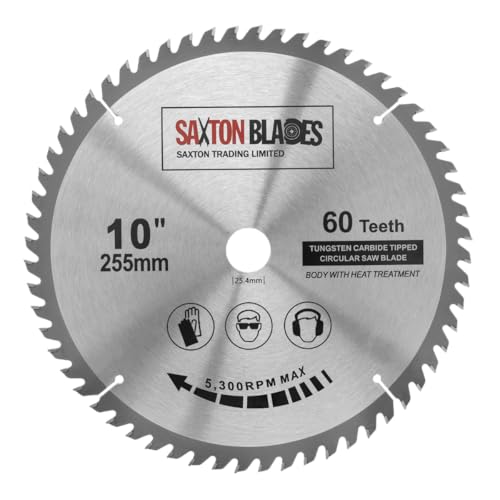
Diameter 255 mm; 60 teeth; 25.4 mm bore; 2.6 mm kerf. This blade is designed to provide a quality finished edge across a range of materials, including softwood, hardwood, plywood, and laminated panels. The blade body is fully hardened steel to resist bending, with tungsten carbide teeth for wear and heat resistance. The positive cutting angle ensures rapid and efficient chip removal, supporting smooth, repeatable cuts on Evolution Rage Saws and similar machines.
The 60-tooth arrangement offers a balance between material removal and edge quality, enabling accurate mitre and cross cuts on larger workpieces. Regular inspection of the blade’s condition, including tooth wear and kerf integrity, will help maintain consistent performance. When working with dense or laminated stock, consider slower feed rates to maximise cut quality and reduce heat buildup.
Buying Guide
- Blade diameter and bore: Match the blade diameter to the saw’s capacity and ensure the bore size fits your spindle with appropriate shims if needed.
- Teeth count and tooth geometry: Higher tooth counts (like 100T) offer finer finishes but slower material removal; mid-range counts (60–80T) are versatile for many tasks. ATB (Alternate Top Bevel) with negative hook minimizes tear-out on a variety of materials.
- Kerf thickness: A 2.6 mm kerf is standard for most mitre blades and balances material removal with accuracy. Thinner kerfs reduce waste but can impact blade strength on heavy stock.
- Material and coating: Tungsten carbide teeth extend blade life and heat resistance; fully hardened steel bodies resist bending and deflection for truer cuts.
- Cut quality vs. speed: For cabinetry and precise joints, prefer finer finishes with higher tooth counts; for rapid framing or rough cuts, 60–80T blades offer a good compromise.
- Compatibility and fit: Check compatibility with your mitre saw model (e.g., Evolution Rage Saws or similar). Some blades include reduction rings to fit multiple bore sizes.
- Maintenance: Regularly clean blades after use, inspect teeth for wear, and replace blades when teeth are visibly damaged or dull to maintain cut quality.
- Application scope: Consider blades designed for a range of materials, including softwood, hardwood, plywood, MDF, laminated panels, and plastics, to cover most projects in a workshop.
- Safety: Always unplug the tool when installing or changing blades and follow manufacturer guidelines for maximum RPM and safe usage.