Starting out with longboards can be exciting but choosing the right board makes all the difference. This guide highlights beginner-friendly longboards from well-known brands, focusing on stability, deck size, and build quality to help new riders in the United Kingdom get comfortable on the pavement. Each option balances control and ease of use, so you can cruise, carve, and improve your technique confidently. Below, you’ll find a quick product snapshot and a buying guide to help you choose what matters most when you’re just starting out.
| Product | Deck Length | Material | |
|---|---|---|---|
| Osprey Cruiser Longboard 39″ | 36″ deck (listed 39″ variant in some listings) | 7-Ply Canadian Maple | Beginners, commuting, snappy carves |
| WHOME Pro Longboards 31″ | 31″ | 8-Ply Alpine Hard Maple | Kids and adults, beginners to advanced |
| Osprey Nexus 39″ Twin Tip | 39″ | 7-Ply Canadian Maple | Beginners, directional carving |
| Osprey Nexus 41″ | 41″ | 9-Ply Canadian Maple | Longer and more stable cruising |
| Opurtdor 46×8 Longboard | 46″ x 8″ | 8-Ply Maple | Beginners wanting extra foot space |
Osprey Cruiser 39″ Longboard

The Osprey Cruiser Longboard features a 7-ply Canadian maple deck noted for durability and stability, essential for beginners who are still building balance. The wider deck aids in balance during long-distance cruising, while a concave design helps prevent wheel bite and enhances carving control. A 36-inch deck length offers a comfortable balance between manoeuvrability and stability, making it a practical option for learners navigating sidewalks and campus routes.
WHOME Pro Longboard 31″
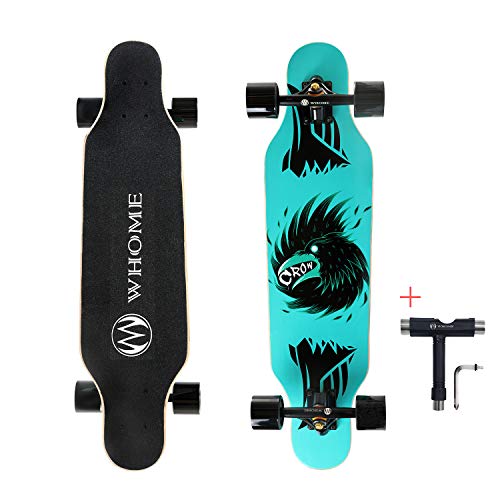
WHOME’s Pro Longboard measures 31 inches with an 8-ply alpine hard maple deck and a 6-inch truck setup. This compact, lightweight design is ideal for beginners and youth, offering easy control and portability. The board features 63 mm wheels and ABEC-9 bearings for smooth rolling and reliable grip, while the textured grip tape provides solid footing during early attempts at cruising and turning. It’s suitable for cruising, carving, commuting, and basic longboard tricks.
Osprey Nexus 39″ Twin Tip

The Nexus 39″ Twin Tip combines a 7-ply Canadian maple deck with a twin-tip design to reduce wheel bite while maintaining carving capability. Its directional carving geometry gives riders ample space to experiment with balance during cruising, making it a friendly choice for beginners who want a bit more length for stability but still crave responsive turning. The twin-tip setup helps distribute pressure during turns, supporting steady progression from cruising to carving.
Osprey Nexus 41″ Twin Tip

The 41-inch Nexus Twin Tip is designed for longer, smoother cruises with a broader stance. Built with a 9-ply Canadian maple deck, it offers increased flex resistance and durability for daily practice and longer sessions. The twin-tip design continues to mitigate wheel bite while enabling confident carving at modest speeds. This model is well-suited for beginners who want a more forgiving ride without sacrificing performance as skills progress.
Osprey Twin Tip 39″ Longboard, Shapes

This 39-inch Osprey Twin Tip Longboard is built for comfortable downhill and flat riding with durable 7-ply Canadian maple and a twin-tip design to reduce wheel bite. It includes strong grip features to maintain traction during cornering and downhills, supporting new riders who are building confidence in faster and longer rides. The board’s design emphasizes stability and control to help beginners master fundamental techniques.
Opurtdor 46×8 Longboard

The Opurtdor longboard adopts a wider 46 x 8 inch deck, providing ample foot space for balance and comfort. The 8-layer maple deck delivers solid support for beginners, with a double kick concave to improve control. Pairing 55 mm 95A wheels with ABEC-11 bearings ensures a smooth, quiet ride and reliable grip. This setup is favorable for learners who want a stable platform for cruising while exploring basic tricks and transitions.
Buying Guide: Key Purchase Considerations
- Deck width and length: Beginners benefit from wider decks (around 31–39 inches) for stability. Shorter boards are more nimble but require more balance. A twin-tip or drop-down design can help with wheel bite and cruising comfort.
- Deck material: Most beginner boards use 7–9 ply maple. Maple provides a reliable mix of strength and light weight; higher ply counts can add durability for longer sessions and more aggressive carving.
- Grip and wheels: Look for adequate grip tape and wheels around 60–63 mm with a softer durometer (80A–83A) for smoother rides on UK pavements and minor rough surfaces.
- Trucks and bearings: Stable trucks (around 6–7 inches) and quality bearings (ABEC-9 or better) make steering more predictable, especially at low speeds.
- Learning terrain: For new riders, choose boards suited to paved sidewalks, campus routes, and gentle hills. Avoid boards designed purely for speed on steep hills until technique improves.
- Portability and weight: If you’ll carry the board frequently, consider a lighter model with a shorter deck and lighter components.
- Maintenance: Check for replaceable grip tape, wheel wear, and hardware rust resistance. Regular checks prolong the board’s life and safety.
When selecting for a beginner, prioritise stability, ease of balance, and predictable steering. The options listed above balance these needs with varying deck lengths and materials, enabling new riders to progress from cruising to carving with confidence. For UK riders, consider pavement conditions and local riding rules to pair the board with appropriate protective gear and safe training routes.