Whether you’re smoothing your swing, grinding your short game, or just keeping your clubs in top condition, a quality golf practice mat is essential. This guide reviews five top-rated mats available in the UK market, highlighting their material quality, stability, and feedback features. Use this to choose a mat that fits your space, budget, and training goals.
| Product | Brand | Key Benefit |
|---|---|---|
| SPURK GOLF Winter Strike Mat | SPURK GOLF | Fairway-like surface with robust protection for practice |
| CHAMPKEY Premium Synthetic Turf Golf Hitting Mat | CHAMPKEY | True-turf surface with heavy-duty rubber backing for stability |
| LynxFlex Golf Hitting Practice Mat | LynxFlex | Large, foldable mat with realistic turf feel |
| Houbobo Golf Hitting Mat | Houbobo | Premium velvet turf with swing-path feedback |
| JAYA Golf Hitting Mat | JAYA | Heavy rubber base with ball tray and dual turf |
The following sections provide in-depth looks at each product, drawing on their listed features to help UK players decide what to buy for home practice, indoor spaces, or outdoor setups.
SPURK GOLF Winter Strike Mat

The SPURK GOLF Winter Strike Mat provides a fairway-like surface designed to protect underlying turf and flooring during practice. It offers a dedicated space for swing drills and ball contact without the need for a turf-covered floor. The primary note is practical rather than feature-dense: it does not include a carry bag, which may influence storage decisions for smaller spaces. The mat’s composition focuses on durability and realistic feel for consistent swings, making it a suitable option for home bays and garages where protecting the floor matters as much as feedback.
CHAMPKEY Premium Synthetic Turf Hitting Mat

CHAMPKEY’s mat stands out for its synthetic turf with a 16 mm true-turf surface that mimics a real fairway or tee box. The package includes a rubber tee and a selection of plastic tees (38 mm, 70 mm, 83 mm), enabling flexible setup for driving, iron shots, or pitch-play. The rubber backing enhances stability and shock absorption, helping to reduce movement during shots and providing a safer practice environment. Additional notes highlight non-slip properties, low odor, and wear resistance, making this mat a strong all-rounder for frequent practice sessions in varied conditions.
LynxFlex Golf Hitting Practice Mat

This LynxFlex mat emphasizes size and practicality for a full practice spectrum. With a 60×40 cm surface, it’s a 2-in-1 collapsible mat that supports driving, chipping, and putting drills. The EVA foam base provides shock absorption to protect wrists and clubs, while the turf surface varies in texture to simulate fairway and rough conditions. The combination supports beginners and intermediate players seeking a versatile, portable training setup, particularly in home spaces where room shape dictates mat choice.
Houbobo Golf Hitting Mat

The Houbobo mat focuses on swing-path feedback, using a velvet turf surface designed to reduce club-face abrasion and provide clear swing-path visualization. The package includes an extra replaceable velvet mat, increasing its usable lifespan between replacements. The premium material aims to deliver visible feedback as you practice, helping players diagnose and adjust swing direction and point of contact. It’s suitable for both indoor and outdoor use, offering a stable base and a clear surface for swing analysis.
JAYA Golf Hitting Mat
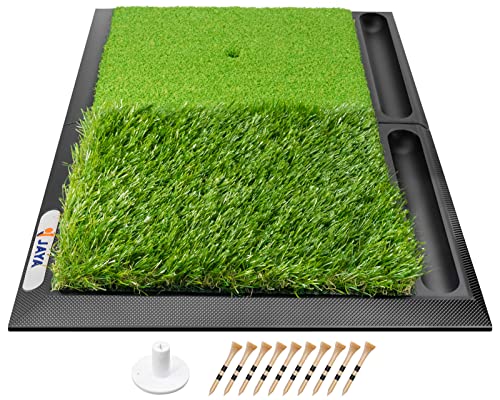
The JAYA mat pairs a heavy rubber base with a dual-turf design: a longer turf for chipping and a shorter turf for full swings. The ball tray keeps up to 12 balls organized, which simplifies practice routines and helps maintain focus during sessions. The rubber backing contributes to stability and impact absorption, reducing wrist strain and protecting clubs. This combination of features supports players seeking a robust, feature-rich mat for varied practice scenarios, from driving to turf-specific drills.
Buying Guide: Key Considerations For Choosing A Golf Practice Mat
- Space and portability: Measure your practice area and consider foldable or multi-zone mats if space is limited.
- Surface realism: Look for turf texture and length that emulate fairway and rough conditions appropriate to your goals.
- Stability and base design: A heavy or non-slip base reduces movement during a swing, protecting floors and wrists.
- Shock absorption: Adequate cushioning helps prevent club-face wear and wrist strain during repeated shots.
- Durability and materials: Durable synthetic turf and robust backing extend mat life, especially for frequent use.
- Feedback features: Some mats include visible swing-path cues or ball-tracking surfaces to aid technique analysis.
- Accessories and setup: Tees, ball trays, and return paths can streamline practice, particularly for indoors.
- Indoor vs outdoor use: Consider weather resistance and cleaning needs if you switch between spaces.
- Maintenance: Check if the mat is easy to clean and store; replacements may be needed for longer surfaces.
- Budget and value: Weigh the upfront cost against expected lifespan and included accessories to gauge value.
When selecting a mat, align its strengths with your practice aims: a pure hitting surface for swing work, or a feature-rich mat for comprehensive green-to-rough practice. For UK players, consider storage, room temperature effects on materials, and whether the mat’s size fits your preferred training corner or garage bay. Each product above offers a distinct balance of realism, stability, and feedback, helping you tailor your home practice routine to your game.