Choosing the right go-to telescope involves balancing aperture, optics, portability and price. This guide highlights five accessible options ideal for beginners and families, with practical features like phone adapters and Tripod stability. Each product is evaluated on optics quality, ease of use, and expandability, helping UK readers compare performance for night sky viewing and daytime observing alike.
| Product | Key Features | Best For |
|---|---|---|
| EACONN Travel 70mm Refractor | 70mm aperture, 400mm focal length, phone adapter, dual eyepieces | Beginners seeking portability |
| Science Mad 30mm Starter | Lightweight, 15x magnification, tripod, lens cap | Young budding astronomers |
| NACATIN 70mm Beginner Refractor | 70mm aperture, multiple eyepieces, smartphone adapter, remote | Family viewing and learning |
| EACONN 70mm & Phone | Portable refractor, two eyepieces, phone mount | Casual observing with capture option |
| Uong Space 70mm Refractor | 70mm objective, 300mm focal length, adjustable tripod | Educational kid-friendly astronomy |
Travel 70mm Refractor

The EACONN 70mm refractor combines a practical aperture with on-the-go usability. Its 400mm focal length delivers crisp images of the Moon’s craters and brighter double stars, while still being portable enough for travel or compact storage. Fully-coated optics enhance light transmission for both celestial and terrestrial viewing, making it a versatile entry-level instrument for UK skies.
Eyepiece options include two replaceable lenses, typically 12.5mm and 20mm, enabling magnifications in a useful range for beginners. A 5×24 finder scope with a crosshair improves target acquisition, particularly when locating brighter planets or star clusters. The included phone adapter supports quick astrophotography or sharing live views with family and friends, expanding the telescope’s educational value.
Considerations for purchase include stability of the mount and overall build quality. While suitable for beginner astronomy, users may later want to upgrade to a sturdier tripod or add extra eyepieces to broaden magnification choices as interest grows.
Starter Telescope For Kids

The Science Mad 30mm telescope is designed for ease of use and portability, making it an approachable option for children and families. Its compact form coupled with a lightweight aluminium tripod supports quick setup in outdoor spaces, allowing young observers to explore landscapes or lunar features without complexity.
With a 30mm objective lens, this model delivers solid magnification suitable for introductory exploration, including up to 15x magnification. A basic kit, including a lens cap and tripod, helps novices protect optics while keeping the system straightforward. It functions as a gentle gateway into astronomy, encouraging curiosity and simple experiments in observing natural phenomena.
Purchasers should weigh the balance between simplicity and future growth—as the child’s interest expands, a slightly larger instrument or additional eyepieces may be considered to sustain engagement and learning.
70mm Refractor With Tripod

The NACATIN 70mm refractor is a versatile entry-level instrument designed for both beginners and adults. Its large 70mm objective lens enhances light transmission for brighter, clearer lunar and planetary views. The scope ships with multiple eyepieces (H6mm, H12mm, H20mm) and Barlow lenses (1.5X & 3X), offering a range of magnifications to suit different targets and seeing conditions.
A notable inclusion is a moon filter, which reduces glare for more comfortable lunar observations. The smartphone adapter and wireless remote provide convenient ways to capture images and videos, enabling easy sharing of discoveries. The telescope’s design emphasizes a stable viewing experience with a durable build that supports beginner learning and gradual skill development.
Practical considerations include ensuring proper collimation and alignment, plus careful handling of glasses to maintain optical clarity over time. This model offers an attractive combination of performance, portability, and value for families in the UK market.
Phone-Ready 70mm Travel Refractor
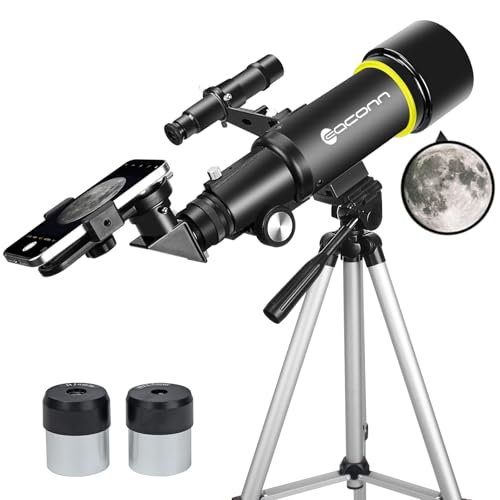
The EACONN travel telescope (70mm, 400mm) offers a compact refractor with full-coated optics for crisp visuals of the Moon and bright planetary targets. Two eyepieces provide a practical 20x to 32x magnification range, suitable for initial stargazing sessions and terrestrial observations. The included phone adapter enables quick photo capture and sharing, which is appealing for social sharing or basic astronomy education.
Key considerations include ensuring a steady tripod and proper alignment to maximise clarity at higher magnifications. While ideal for beginners, this model can also serve as a portable secondary telescope for travel or school projects. Prospective buyers should assess storage space and how often they plan to transport the instrument.
Educational 70mm Space Telescope

The Uong Space Telescope is a beginner-friendly option emphasizing educational value. With a 70mm aperture and a focal length around 300mm, the telescope delivers brighter views of the Moon, planets, and star fields. The adjustable tripod supports multiple viewing angles, enhancing comfort during extended sessions. The kit includes a smartphone adapter, making it straightforward to capture and share celestial observations with peers or family.
From a learning perspective, this model prioritises ease of assembly and intuitive operation, which is beneficial for children and adults starting in astronomy. In addition, the relatively compact design makes it suitable for occasional field use or classroom demonstrations. Users should consider weatherproofing and protective storage to maintain optical clarity over time.
Buying Guide: Key Purchase Considerations And Comparisons
Target audience and purpose: Beginners often benefit from moderate aperture (70–90mm) and simple mounts. For traveling or school demonstrations, portability and quick setup become decisive factors. Families may prefer bundled kits with tripods, phone adapters and easy alignment features for engaging multiple ages.
Optical quality and magnification: Optics quality is linked to the aperture, coatings, and focal length. A 70mm refractor with multiple eyepieces and a basic finder scope provides reliable performance for lunar, planetary, and terrestrial viewing, while higher magnification must be matched with stable mounting to avoid blurry images.
Mount and stability: An adjustable mount and sturdy tripod minimize vibrations, especially at higher magnifications. German Equatorial mounts and AZ (alt-azimuth) mounts are common; consider what the user will predominantly observe when choosing between tracking capabilities and ease of use.
Accessories and future growth: Look for beginner-friendly kits that include phone adapters for astrophotography, basic eyepieces, and optional add-ons like Barlow lenses. A telescope that can be upgraded with better eyepieces or a more stable tripod can extend its useful life as interest grows.
Portability and storage: For UK users, ease of transport from garden to countryside observing sites is valuable. Compact models with quick setup and lightweight materials suit families and travellers, while larger scopes prioritise light gathering and resolution for more serious stargazing.
Budget and value: Entry-level models provide good value by offering essential features without overwhelming complexity. Consider total cost of ownership, including accessories and potential upgrades, to determine the most cost-effective option for your needs.
Maintenance and care: Regularly check for lens cleanliness, ensure proper alignment, and store optics in protective cases. Coatings and lens cleanliness materially affect image brightness and clarity over time.