When venturing into the UK countryside, a dependable compass is a trusty companion. This guide highlights five highly regarded hiking compasses, balancing accuracy, durability and ease of use to help hikers, campers and outdoor enthusiasts stay on course in diverse conditions.
| Product | Brand | Key Features |
|---|---|---|
| Sportneer Waterproof Hiking Compass | Sportneer | High-precision readings, sight lens, level operating, waterproof and shockproof |
| Proster Clinometer Hiking Compass | Proster | Clinometer for height/slope, fluorescent scale, high precision |
| Silva Ranger S Black | Silva | Long-distance bearings, mirror sighting, rotatable housing, declination scale |
| TurnOnSport Orienteering Compass | TurnOnSport | Acrylic baseplate, 360° bezel, magnifying glass, portable |
| Rhinocerosdance Military Compass | Rhinocerosdance | Waterproof metal case, luminous dial, sighting lens, robust navigation |
These selections cover a range of uses—from detailed map reading and long-distance bearings to rugged field navigation. Each model offers practical features designed for reliability in the outdoors, whether you’re trekking a Welsh hillside or exploring a Scottish glen.
Sportneer Waterproof Hiking Compass

The Sportneer compass emphasizes high-precision readings with a sight lens that magnifies the dial for accurate bearings. To achieve optimal performance, keep the compass level so the magnetic needle can rotate freely and point to magnetic north. Its metal base and cover provide a waterproof and shockproof build, making it suitable for rugged outdoor conditions. This model suits camping, hiking, climbing and other outdoor activities where dependable bearings matter. Its straightforward design aids in quick readings, an advantage in changing weather or low-light situations. A carrying bag is included for safe transport between adventures.
Proster Clinometer Hiking Compass

The Proster compass features a clinometer for measuring height differences and slopes, alongside a fluorescent scale for reading in dim environments. Its high-precision accuracy comes from a thermo-elastic liquid-filled capsule and a floating dial, with a vertical lubber line aiding precise bearing use. The device supports diverse activities—from hiking and camping to geology fieldwork—thanks to its robust sighting optics and readable data in low light. A carrying bag is included, making it easy to pack and access on longer expeditions or field trips.
Silva Ranger S Black Compass

The Silva Ranger S Black supports long-distance navigation with a rotatable housing and a mirror sighting feature, enabling you to view the dial and background simultaneously for precise bearings. It includes a declination scale inside the capsule to help adjust for magnetic variation. The rubber grip bezel offers secure handling, even when hands are cold or wet, and the compass is designed for hikers and mountaineers who need dependable performance across open terrain and varied routes. The mirror sighting capability is particularly advantageous for aligning bearings in challenging environments.
TurnOnSport Orienteering Compass
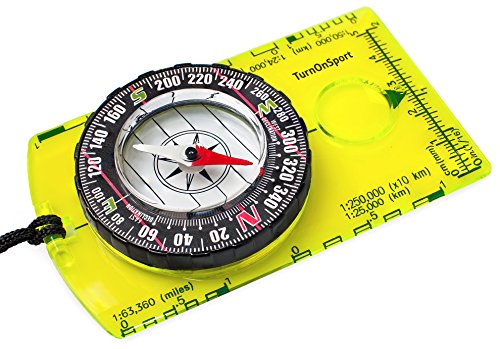
The TurnOnSport orienteering compass combines an acrylic baseplate with a 360-degree rotating bezel and a magnifying glass to aid map reading. It includes a portable and lightweight design suitable for both beginners and more experienced navigators. The magnetic needle is housed in a liquid-filled capsule for stable readings, and the ruler scale on the sides supports precise route mapping. This compass is well-suited for field trips, camping and educational use where map reading and quick bearings are essential. It is practical for youth groups and adult hikers alike, offering reliable performance without complexity.
Rhinocerosdance Military Compass

This military compass offers a rugged waterproof metal case, a luminous dial and a sighting lens, making it suitable for demanding outdoor navigation. The strong build is designed to withstand rugged environments, with a clear degree scale and additional features to assist in plotting routes and taking bearings. It is a practical option for hikers, scouts and enthusiasts who require dependable performance in poor visibility or night-time use. The luminous dial aids reading in low-light conditions, contributing to safer navigation after sundown or in murky weather.
Buying Guide: Key Purchase Considerations For Hiking Compasses
Choosing the right compass involves balancing accuracy, durability and user-friendliness. Consider these aspects to pick a model that fits your needs on UK trails.
- Accuracy and readability: Look for a liquid-filled compass with a precise dial and a readable scale. A magnifying sight or lens helps with map-based bearings and uses on detailed topographic maps.
- Durability: For rugged weather and uneven terrain, select a compass with a sturdy metal or reinforced plastic housing, waterproofing and a reliable lid or cover to protect the dial.
- Sight features: A mirror sighting or sighting lens improves bearing accuracy, especially at long distances or when terrain requires precise alignment with your map.
- Additional measurement tools: Clinometers, bubble levels and declination scales extend utility for backcountry navigation and map reading, though they add complexity. Choose based on experience level and needs.
- Portability and weight: If you hike light or travel with a daypack, a compact compass with a protective case can be advantageous. For scouts and training scenarios, a larger, feature-rich model may be preferable.
- Ease of use in low light: Fluorescent or luminous indicators help reading the compass after sunset or during dull weather. Consider models with glow-in-the-dark features if you frequently hike in shaded or evening conditions.
- Map-reading compatibility: If you plan to rely heavily on maps, a baseplate design with a clear ruler scale and azimuth bearing helps with precise route planning.
- Price and maintenance: Higher precision and additional features may justify a higher price. Check for replacement parts or service options if the device is used in demanding environments.
In practice, hikers should match a compass to their typical use case: long-distance navigation with detailed map work benefits from a mirror sighting and declination features, while casual day hikes may prioritize simplicity and durability. A backup navigation plan—such as a compass paired with a GPS device or offline map app—adds resilience on longer expeditions. Weather resistance, reliable bearings and ergonomic handling are universal advantages across the best hiking compasses.