Plywood cutting demands blades that deliver clean edges, minimal tear-out, and steady performance across softwood, hardwood, and engineered sheets. The following five circular saw blades are among the most suitable options for UK workshops when working with plywood. Each selection balances tooth design, kerf width, and blade material to help achieve precise, finished cuts with reduced effort and heat buildup.
Summary of chosen products:
| Product | Blade Diameter | Teeth | Bore | |
|---|---|---|---|---|
| Saxton TCT Circular Wood Saw Blade | 160 mm | 80 | 20 mm | 2.2 mm |
| BAUBECK Circular Saw Blade | 165 mm | 80 | 20 mm (16 mm reducer) | — |
| SabreCut 165 mm 24T | 165 mm | 24 | 20 mm | — |
| Saxton 165 mm 80T Thin Kerf | 165 mm | 80 | 20 mm (16 mm reducer) | 1.5 mm |
| DEWALT Elite 165 mm 24T | 165 mm | 24 | 20 mm | — |
Saxton TCT Circular Wood Saw Blade

The Saxton TCT Circular Wood Saw Blade is designed for versatility across woodworking tasks, including plywood. Its 160 mm diameter and 80 teeth provide a balance between smooth cross-cuts and efficient material removal. The 20 mm bore (with a 16 mm reduction ring included) supports common saw spindle sizes. A 2.2 mm kerf allows controlled cuts with reduced deflection, while tungsten carbide teeth enhance wear resistance. The blade’s geometry supports fast chip removal and clean edges, making it suitable for precise plywood work along and across the grain.
Key features include a hardened steel blade body for rigidity, and a positive cutting angle to maintain efficient swarf removal. This blade aims to deliver accurate cuts with less vibration, contributing to high-quality plywood edges in both softwoods and sheet materials used in cabinetry and furniture.
BAUBECK Circular Saw Blade
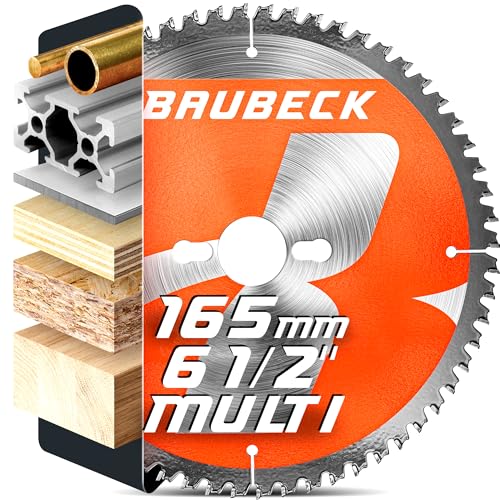
The BAUBECK blade is a robust 165 mm option with an 80-tooth count and 20 mm bore, compatible with a range of 18V tools when used with the 16 mm adapter. It is formed from hardened steel and uses micro-grain tungsten carbide teeth to maintain sharpness and resist wear. The fine tooth design supports clean, fine cuts in plywood, MDF, and laminated panels, while the blade’s multi-material capability expands use to aluminum and mild steel in some setups. Its design prioritises minimal blade deflection and stable cuts for confident plywood work, particularly in delicate cross-cuts where edge finish matters.
With a focus on long-lasting sharpness and reduced breakage, this blade suits woodworkers who demand consistent results when finishing plywood sheets for cabinetry and decorative panels. The multi-material capability broadens its appeal for mixed-material projects.
SabreCut 165mm 24T

The SabreCut 165 mm 24T blade is designed for high-precision framing and cross-cutting tasks. Its ultra-thin kerf and NiCo-alternating tooth bevel (ATB) design enable exceptionally clean cuts in plywood and other sheet materials. With 24 teeth, it strikes a balance between rapid material removal and edge quality, making it suitable for tasks where a smooth plywood finish is essential. The blade is compatible with standard 20 mm bores and is engineered for professional framing work, including cross cuts and rip cuts in plywood and MDF.
Key benefits include enhanced edge quality, reduced tear-out in plywood, and durability for repeated use in demanding workshop environments. The thin kerf minimizes waste and motor workload, contributing to efficient cutting workflows.
Saxton 165mm 80T Thin Kerf

The Saxton 165 mm 80T thin kerf blade is tailored for cordless saw use, featuring a 1.5 mm kerf to minimise waste and reduce push force. The blade’s 20 mm bore with a 16 mm reducer suits common cordless tool setups. Its 1.0 mm plate thickness supports precise cuts, particularly along the grain in plywood and other sheet materials. The tungsten carbide teeth maintain durability, while the thin kerf supports fast, clean cuts with less heat generation. This blade is positioned for refined edge finishes in plywood-heavy projects such as paneling and cabinetry.
Designed for along-the-grain and cross-cut tasks, it provides a reliable edge quality on softwood, hardwood, and engineered panels, with a focus on cordless tool compatibility and thin kerf efficiency.
DEWALT Elite Circular Saw Blade

The DEWALT Elite Series blade delivers reliable cutting performance with a focus on a thin kerf and straight cuts, reducing push force and enabling smoother plywood work. The 165 mm diameter and 24T configuration are well-suited for clean cross-cuts and rip cuts in plywood, MDF, and similar sheets. The blade’s engineering aims for reduced heat buildup and consistent edge quality, making it a dependable choice for professional carpentry and home workshop use. Its robust construction supports long-term performance in demanding cutting tasks across various wood-based sheets.
SabreCut 190mm 24T

This SabreCut 190 mm blade offers a 24-tooth, ultra-thin kerf design for framing plywood and MDF. The 30 mm bore suits larger table saw setups, enabling stable and accurate cuts on plywood sheets. The NiCo tooth construction provides durability and clean cutting action, making it a strong choice for high-precision plywood tasks in workshop or on-site settings. It is particularly useful where fast, straight cuts with minimal tear-out are required across thicker plywood panels and composite sheets.
Saxton 165mm 80T Thin Kerf (Cordless)
This cordless-optimised Saxton blade combines a thin kerf with an 80-tooth count to deliver clean plywood cuts with minimal waste and reduced motor load. The 20 mm bore with a 16 mm reducer ensures compatibility with common cordless saws. Its hardened blade body and tungsten carbide teeth promote durability and edge retention, making it suitable for frequent plywood finishing and cabinetry work in battery-powered tools.
Buying Guide: Key Considerations For Plywood Cuts
- Blade diameter and kerf: A larger diameter with a thin kerf reduces vibration and improves edge quality, while a thinner kerf minimises waste and push force, important for plywood where tear-out matters.
- Tooth count and geometry: Higher tooth counts (e.g., 80T) yield smoother finishes on plywood, especially in cross-cuts and fine cabinetry. ATB designs help achieve cleaner edges in laminated sheets.
- Material and durability: Carbide-tipped teeth resist wear and heat buildup, extending blade life when cutting plywood composite panels and veneers.
- Blade thickness and rigidity: Thin-kerf blades reduce load on power tools and minimize deflection, but should still be rigid enough for stable cuts in plywood sheets.
- Bore compatibility: Ensure the blade’s bore matches your saw’s arbor or use a reducer ring as needed (common sizes include 20 mm and 16 mm).
- Coatings and maintenance: Non-stick or resin-resistant coatings help keep the blade cutting smoothly by reducing buildup on plywood resins.
- Application scope: For versatile woodworking, consider blades designed for cross-cuts in plywood, MDF, chipboard, and laminated panels, providing clean edges across diverse sheet materials.
- Safety and compatibility: Always use the correct blade for the saw type (table vs. circular) and follow tool manufacturer guidelines for speed, mounting, and guards.