When working with medium-density fibreboard (MDF), the right circular saw blade can make a noticeable difference in edge quality, heat buildup, and overall accuracy. The following selections are highly relevant for MDF cutting, offering carbide teeth, thin kerfs, and compatible bore sizes to suit common UK saw models. Each option is chosen for balanced performance, durability, and the ability to produce smooth finishes on MDF, plywood, and similar sheet materials. The list also reflects blades that perform well on both softwood and hardwood, should your project require versatility.
| Blade | Diameter | Teeth | Bore |
|---|---|---|---|
| Saxton TCT 250mm 80T | 250 mm | 80 | 30 mm (reduction rings included) |
| Saxton 165mm 80T Thin Kerf | 165 mm | 80 | 20 mm (reduction ring included) |
| SabreCut 165mm 24T | 165 mm | 24 | 20 mm |
| Trend 190mm 24/40/60T Pack | 190 mm | 24/40/60 | 30 mm |
| Baubeck 185mm 80T | 185 mm | 80 | 20 mm (+16 mm ring) |
Note: All selections are suitable for MDF, with variations in kerf, tooth configuration, and bore size. The right choice depends on your saw compatibility, desired finish, and whether you prioritise faster material removal or a finer cut.
Saxton TCT 250mm 80T For MDF Edge

The Saxton TCT Circular Wood Saw Blade, 250mm diameter with 80 teeth and a 30mm bore, is designed for clean, precise cuts in a range of materials including MDF. Its 2.6mm kerf enables efficient material removal while maintaining accuracy. The blade is built with a hardened steel body to resist bending and deflection, ensuring stability during long cuts. Tungsten carbide teeth offer wear and heat resistance, supporting consistent performance across repeated passes. Reduction rings of 16, 20, and 25mm enhance compatibility with different saw brands, making this blade a versatile option for MDF projects in the workshop. The positive cutting angle helps clear chips quickly, reducing heat buildup and tear-out on MDF faces.
Features highlighted support versatile use across softwood, hardwood, plywood, and engineered panels like MDF, as well as laminated and fibre-reinforced plastics. For users targeting a quality finished edge on MDF, the combination of a strong tooth geometry and robust blade body helps achieve repeatable results with minimal warping or chipping.
This blade is well-suited to along-the-grain and cross-cut tasks, particularly where a larger diameter is preferred for deeper cuts. Keep in mind that MDF can be susceptible to dulling if the blade is used aggressively on hard laminates; a slow, steady feed rate is advised to preserve edge quality and blade life.
Saxton 165mm 80T Thin Kerf for Cordless Saws

The 165mm Saxton blade features 80 teeth and a narrow 1.5mm kerf, designed for cordless circular saws. This thinner kerf reduces material waste and requires less power to achieve clean cuts, which is advantageous when cutting MDF where heat generation and tear-out can be concerns. The blade includes a 16mm reduction ring to adapt to larger bore saws commonly used in DIY and professional setups. Its fully hardened steel body supports precision cutting, and the tungsten carbide teeth provide strong wear resistance, maintaining sharpness over numerous MDF passes. A positive tooth geometry supports efficient chip removal for smoother edges on MDF surfaces.
For MDF work, the key advantage is slower blade resistance and less vibration, yielding tighter, cleaner edges. This blade is particularly beneficial where a lightweight, precise cut is desired in sheet materials, and where cordless saws require an efficient, reliable blade to extend battery life and performance between charges.
Users should monitor feed rate and avoid forcing the cut in thick MDF panels. Pausing as needed allows the blade to cool and prevents heat-related edge scorching or scorching on the surface layer.
SabreCut 165mm 24T For Fine Cuts

The SabreCut 165mm 24T blade is engineered for smooth cross-cut and rip cuts on natural timber and engineered woods like MDF and chipboard. Its ultra-tough NiCo alternating tooth bevel (ATB) teeth provide exceptionally clean cuts, reducing tear-out on MDF faces. The blade’s 20mm bore accommodates common saw spindles, and the low tooth count aids aggressive material removal while maintaining edge quality on flat-sheet MDF panels. The thin kerf design limits waste, enabling less energy use and quicker progress through panels. This blade suits framing and cabinetry projects where tidy MDF faces are essential for paint-ready edges.
When using a 24-tooth configuration, users should expect faster cut rates but potentially more visible tear-out on highly polished or highly laminated MDF. Pair this blade with a slow, controlled feed to achieve a balanced finish, particularly on larger MDF sheets.
Trend 190mm 24/40/60T Pack

The Trend wood circular saw blade pack provides three tooth configurations—24T, 40T, and 60T—for versatile MDF work. The 2.6mm kerf supports efficient cutting while maintaining a reasonable stability level for sheet materials. The ATB tooth design emphasizes clean finishes, reducing tear-out on MDF and similar substrates. This versatility makes the Trend pack a practical choice for workshops needing to switch between tasks such as rough cuts, finish cuts, and fine finishing of MDF panels. The 190mm diameter and 30mm bore enable compatibility with a broad range of circular saws.
For MDF projects, starting with the 24T option yields rapid material removal, while the 40T and 60T blades can deliver smoother finishes on exposed MDF edges, particularly useful for cabinet doors and panel faces that require paint or veneer work. The full pack offers value and flexibility for varying cut demands across MDF projects.
Baubeck 185mm 80T For MDF and Metals
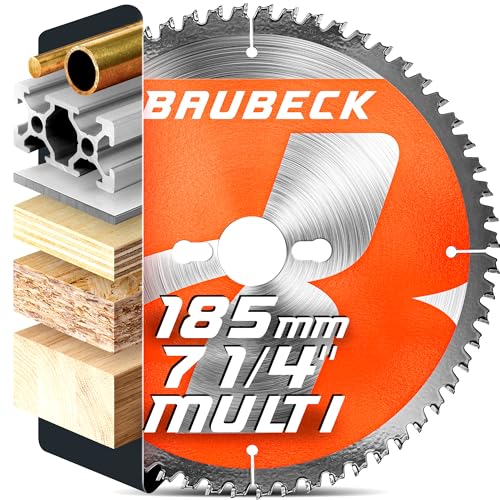
The Baubeck 185mm 80T blade is built for ultra-fine, precise cuts with a focus on durability and multi-material compatibility. Constructed from fully hardened stamped steel, it minimizes deflection and maintains stability during MDF cuts. Micro-grain tungsten carbide teeth promote long-lasting sharpness, enabling consistent finishes on MDF, softwood, hardwood, plywood, and other sheet materials. The tooth design emphasizes reduced breakage and cleaner edge quality, making this blade a reliable option for detailed MDF work where a fine finish is desirable. The blade is compatible with Evolution, Hikoki, and Dewalt platforms that accept a 185mm size with a 20mm bore, plus an added 16mm reduction ring for broader compatibility.
For MDF-focused projects, the 80T configuration provides a fine cut profile with good edge integrity, reducing the risk of tear-out on exposed faces. It is important to maintain proper feed rates and avoid aggressive plunging to preserve edge quality on sensitive MDF surfaces.
Buying Guide
Key considerations when selecting a circular saw blade for MDF:
- Tooth count and cut quality: Higher tooth counts (e.g., 80T) are preferred for fine, smooth finishes on MDF, especially for panels and cabinet faces. Lower tooth counts (e.g., 24T) cut faster but may show more tear-out on MDF; thin-kerf blades can help mitigate heat buildup.
- Kerf width: Thin kerf blades (around 1.5–2.0 mm) reduce resistance and are beneficial for cordless saws or where power is limited. A wider kerf increases material removal per pass but can generate more heat.
- Bore compatibility: Ensure the blade fits your saw’s bore size (commonly 16 mm, 20 mm, or 30 mm). Reduction rings can help adapt blades to different machines.
- Material construction: Fully hardened steel bodies and carbide teeth deliver durability and edge retention. For MDF, heat resistance and wear resistance are important to maintain edge quality over multiple cuts.
- Application scope: While MDF is a common use, consider blades capable of mixed-material work if you frequently cut plywood, laminates, or fibre-reinforced plastics. ATB or TCG tooth designs influence cut quality and chip ejection.
- Blade life and maintenance: Regular cleaning of resin and pitch from MDF is essential. A sharp edge and proper feed rate help extend blade life and preserve cut quality.
- Saw compatibility: Check that the blade length and mounting configuration suit your specific model, whether it is a fixed base, plunge, or cordless circular saw.
Summary of selected blades for MDF projects: The Saxton 250mm 80T and 165mm 80T thin-kerf blades are well-suited for larger and mid-sized MDF sheets, offering robust carbide teeth and reliable edge finishes. SabreCut’s 24T blade focuses on fast, clean rip cuts where MDF edges are already well-supported. Trend’s 190mm pack brings versatility with multiple tooth counts for varied finish needs, while Baubeck’s 80T blade emphasizes durability and multi-material capability for MDF and beyond.