Discover affordable dive computers that deliver reliable depth, nitrogen and safety features without breaking the bank. This guide highlights five cost-effective options from trusted brands, focusing on clear displays, straightforward controls, and essential dive data. Whether you are new to diving or adding a spare computer to your kit, these models balance value with performance for recreational dives.
| Product | Brand | Key Feature |
|---|---|---|
| Leonardo Diving Computer | Cressi | Simple one-button interface |
| Raffaello Diving Computer | Cressi | Large high-contrast screen |
| Donatello Diving Computer | Cressi | Professional wrist design |
| Puck 4 Dive Computer | Mares | Multi-gas, Bluetooth capable |
| Seac Action Dive Computer | SEAC | Scuba and freediving modes |
The options below are selected for balance between price and essential features, including straightforward menus, Nitrox capability, and reliable depth tracking. Each product section includes a brief snapshot of capabilities to help you compare at a glance.
Leonardo Diving Computer

The Cressi Leonardo 2.0 is designed for training and recreational diving with a simple one-button interface. It offers easy access to Air Nitrox and Gauge modes, making it suitable for beginners and open-water students. Its high-contrast, large UFDS display presents information clearly, with backlighting for low-visibility or night dives. Nitrox management goes up to 50 percent, and it includes adjustable PPO2 levels, Deep Stop settings, altitude adjustments, and safety configurations using the CRESSI RGBM algorithm. Alerts cover ascent rate violations and no-decompression limits, supporting safe multi-day dives.
Raffaello Large Screen Computer

This model features a new generation underwater computer with a large, high-contrast, backlit rectangular screen for easy data readability. It’s slim and durable, built with a shell reinforced by advanced nano-fillers technology. Operational versatility includes Air, Nitrox, Gauge, and Free/Apnea modes, plus a built-in compass for navigation. It supports three Nitrox gas mixtures and a dive data display that covers depth, water temperature, dive count, maximum depth, and more. The device is designed to support advanced divers who require flexible gas management during dives.
Donatello Professional Wrist Computer

The Donatello line by Cressi emphasizes a professional wrist experience with a large, easy-to-navigate UFDS display and a single push button for navigation. This model is built by a family-owned company with a long history in water sports, offering reliable performance for professional or serious recreational divers. The simplified menu structure helps divers access essential features quickly, while ensuring dependable depth, timing, and safety information during dives.
Puck 4 Dive Computer
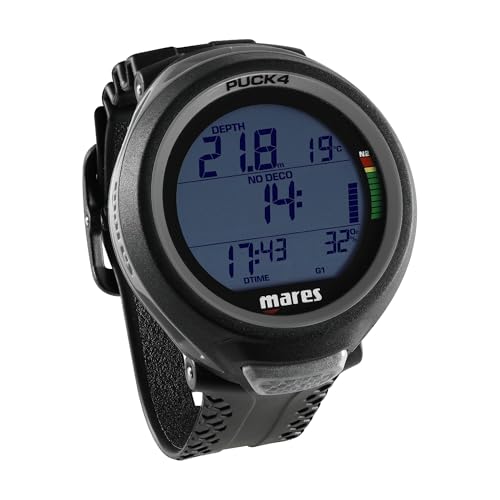
The Mares Puck 4 delivers a compact, reliable dive computer featuring multiple gas options, a 6C with customizable air gradient factors, and a multi-blend depth gauge. It supports a 100-dive logbook memory and Bluetooth connectivity for dive data transfer. A rugged, user-friendly interface supports quick access to essential data, making it suitable for divers who want a capable, affordable computer with modern data logging and maintenance capabilities.
Donatello Professional Wrist – Black/Blue

The Donatello range includes a professional wrist diving computer with a wide UFDS screen for easy navigation and clearly organized menus. It uses a single push button approach to control functions, aimed at reliability and straightforward operation. Italian design and production underpin the device, ensuring robust performance for recreational and professional-grade diving scenarios alike.
Buying Guide: Key Purchase Considerations
- Display and readability: Prioritise models with large, high-contrast UFDS screens and backlighting for good visibility underwater and in low-light conditions.
- Gas management: Check if the computer supports multiple Nitrox blends and adjustable PPO2. For some divers, a device with three Nitrox mixtures offers greater flexibility on longer trips.
- Decompression models: Look for reputable algorithms (RGBM, Bühlmann) and clear alert systems for ascent rates and no-decompression limits to support safe dives.
- Durability and design: Consider a robust housing, water resistance, and ease of use with a single-button interface or few controls, especially for training scenarios.
- Battery and maintenance: Assess battery type, replaceability, and scheduling for routine maintenance. Bluetooth or dive-log transfer can simplify record-keeping.
- Logbook and data access: A long dive-log memory and easy data export help with post-dive analysis and training progress.
- Compatibility: If you own other dive gear or apps, ensure compatibility for data transfer and compatibility with common nitrox mixes and dive planning features.
- Price-to-feature balance: For a budget-conscious buyer, prioritize essential functions (depth, time, gas, no-deco limits) over niche modes unless needed for diving style.