Finding the right beginner-friendly RC plane can be challenging, especially for newcomers in the UK. This guide highlights five entry-level options from 4DRC, Makerfire and KBIBCK, focusing on stability, easy takeoff methods, and forgiving handling. Each model supports simple controls, beginner-friendly modes, and clear learning curves to build confidence before moving to more advanced aircraft.
Summary of chosen products
| Product | Brand | Key Benefit | Take-off Method |
|---|---|---|---|
| V50 RC Plane | 4DRC | 2 take-off modes and long flight times | Hand-throw / Glide |
| Foam RC Plane (Adults/Kids) | 4DRC | Ready-to-fly with 3 speeds | Hand-throw / Glide |
| G6 RC Plane | 4DRC | 2 batteries for extended flights | Hand-throw / Glide |
| FX-803 Blue | Makerfire | Durable EPP, 15 min flights | Ready to Fly |
| Mini RC Plane | KBIBCK | Compact micro plane with stabilisation | Ground takeoff / Hand-launch |
V50 Beginner RC Plane
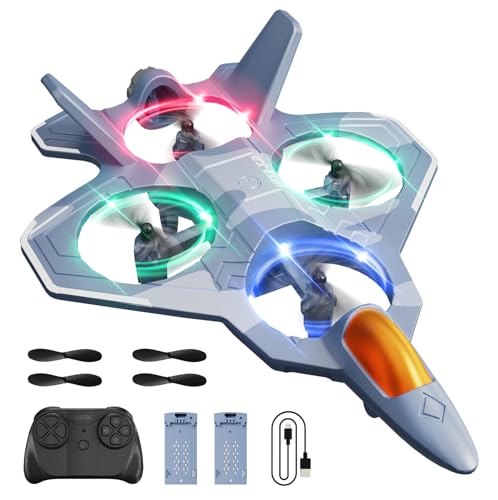
The 4DRC V50 is designed for beginners with its Ready-to-Fly setup and two take-off methods, including hand-throw and glide. Its 2.4GHz remote supports 360° stunts, one-key takeoff and landing, return, and an emergency stop, all aimed at simplifying initial flights. Headless mode and altitude hold reduce direction-sensing challenges for new pilots, while 3 speed modes offer gradual progression. The included dual batteries extend flight sessions; each battery can provide up to 30 minutes of flight time, giving learners ample practice without frequent recharges. The LED lighting adds visibility for daytime and dusk flights. This model is suitable for ages and tends to appeal to first-time flyers seeking quick, confident flights, with a focus on stable, forgiving handling.
Features to note include: 4 high-power motors deliver stable lift, a trim function for precise adjustments, and two take-off paths to accommodate varying beginner environments. Beginners should practise in an open space to account for wind and ensure safe takeoffs and landings. Overall, the V50 balances ease of use with enough capability to grow into more advanced maneuvers as confidence builds.
Foam RC Plane For Beginners

This 4DRC foam RC plane is aimed at beginners and families, offering straightforward control with headless mode and three speed settings. Its lightweight foam construction supports forgiving landings and reduced crash impact, while the included manual provides clear operating steps. The 360° flips and smooth throttle response enable learners to explore aerobatics gradually, without being overwhelmed by complex input. The control layout is simplified so first-timers can master essential maneuvers—takeoff, hover, and controlled descent—before attempting more advanced stunts.
Additional considerations include the built-in stability features that help maintain steady flight in varying conditions. The plane is suitable for casual backyard sessions or open parks, aligning with beginner needs for low-stress learning. While it excels in ease of use, pilots should still choose calm days and open spaces to maximize a positive learning experience.
G6 RC Plane With Two Take-off Modes

The 4DRC G6 RC Plane combines two take-off modes with a stabilisation system to ease beginners into flight. It offers 3D capability, circling, and forward/backward motion with two flight speeds to accommodate learning progress. The inclusion of two batteries supports up to 30 minutes of flight time, reducing downtime between practice runs. Bright LED lights provide visual appeal and improved visibility for after-dark flying. The 2.4GHz system allows multiple aircraft to operate concurrently, making it suitable for group practice or family use.
Stability is a core feature here: the internal stabilization helps prevent erratic movements during early flights, while the hand-throw and glide take-off options provide flexible setup depending on the environment. For new pilots, the G6 presents a balanced mix of forgiving handling and engaging potential, with clear progression paths as skills improve.
FX-803 RTF Blue

The Makerfire FX-803 RTF is another Ready-To-Fly option designed with beginners in mind. It ships with a 2.4GHz radio and built-in 6-axis gyro, promoting stability and ease of use for new pilots. Each flight package includes multiple lightweight LiPo batteries, enabling extended sessions starting from a comfortable 10-15 minutes per battery depending on throttle input and flight style. The EPP foam construction provides durability against bumps during learning, while a simple control layout helps novices execute basic takeoffs, hovering, and controlled landings with minimal frustration. The blue variant adds a distinct visual style for pilots seeking a standout model in the sky.
Practical considerations include ensuring ample open space and moderate wind conditions for first flights. While aimed at beginners, the FX-803 still offers enough responsiveness for gradual skill development, including transitions between hover and forward flight, and gentle aerobatics as confidence grows.
G6 Red Variant RC Plane

The red version of the 4DRC G6 RC Plane continues to offer dual take-off modes, stabilization, and two batteries for extended flight sessions. The emphasis remains on accessible learning with a sturdy build and bright LED lighting for night operations. As with other 4DRC models, the 2.4GHz remote control facilitates multi-plane operation, which is beneficial for families and clubs experimenting with multiple beginners simultaneously. Pilots can practice precise maneuvers in controlled conditions and gradually increase flight complexity as mastery grows.
Key considerations for this model include the balance between stability and maneuverability. Start with hand-launch takeoffs to minimize risk, use the stabilization system to maintain steady altitude, and gradually introduce rougher maneuvers as confidence builds. The two-battery setup offers a practical approach to extended practice sessions without excessive downtime.
Buying Guide: Key Considerations for Beginner RC Planes
- Stability and beginner modes: Look for stabilization features (gyro/altitude hold) and headless mode to simplify orientation for new pilots.
- Take-off options: Models with hand-throw or glide take-off provide flexible setups; start with gentle launches in open spaces.
- Flight time and batteries: Two batteries or longer flight times reduce downtime between practice sessions, enabling more effective learning.
- Durability: Foam or EPP materials absorb crashes better, important for beginners who may over-correct or misjudge landings.
- Control range and radio system: A reliable 2.4GHz link supports multiple planes and reduces control interference during practice with others.
- Safety and environment: Practice in open parks or wide fields away from people, animals, and obstacles to minimise risk.
- Size and portability: Compact micro planes are easy to transport; larger foam planes offer steadier flight and more visible performance for beginners.
- Ease of setup: Ready-to-Fly (RTF) packages with included transmitter reduce the initial setup burden for newcomers.