Developing fine motor skills is crucial for handwriting, dressing, and everyday tasks. The following selection of toys and activities focuses on precise hand movements, hand-eye coordination, and logical thinking. Each option supports independent play or guided learning, making them ideal for UK households, nurseries, and classrooms seeking engaging resources that promote steady skill growth.
| Product | Key Benefit |
|---|---|
| LEADSTAR Montessori Colour Sorting Toys | Color-based sorting, counting, and tweezers practice |
| Learning Resources Helping Hands Fine Motor Tool Set | Hand strength, coordination, and sensory play |
| QXCFTW Fine Motor Skills Toys | Bead threading, color and shape learning |
| edxeducation Jumbo Tweezers | Large-tong precision grip, sorting activities |
| Potatomato Montessori Busy House | Practical life skills, latches and problem-solving |
Montessori Colour Sorting Fun

LEADSTAR’s Montessori Colour Sorting Toys offer a comprehensive set designed to develop fine motor precision and early maths concepts. The kit includes 36 animal pieces in six bright colors, two tweezers, six sorting cups, and two dice housed in a transparent storage bucket. Children engage in counting, sorting, and matching activities, using tweezers to transfer items between cups. This process supports color recognition, hand-eye coordination, and basic operations such as counting, addition, and subtraction. The Montessori approach encourages independent exploration while reinforcing classroom-ready skills in a home setting.
Features emphasize a multisensory experience: sorting by color, manipulating small parts, and comparing quantities. The included animals—rabbit, monkey, bear, frog, parrot, and owl—offer familiar visuals that can spark imaginative play. As a classroom or home learning tool, the kit supports small-group activities and individual practice, aligning with early years curricula focusing on mathematical foundations and fine motor control.
Potential considerations include ensuring supervision when using small components and providing storage to prevent misplacement of pieces. The durable plastic construction supports daily use in homes and classrooms alike. This set is well-suited for Montessori-inspired activities and STEM programs that require varied manipulatives to foster ongoing skill development.
Fine Motor Tool Set For Classrooms
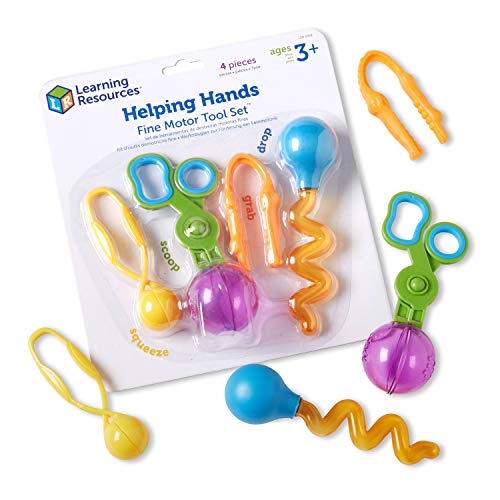
Learning Resources Helping Hands Fine Motor Tool Set is designed to build essential hand strength and coordination for writing and dressing tasks. The set supports sensory play across different textures and materials, making it suitable for water trays, sand, and messy play. Its durable plastic construction is easy to clean and suitable for both indoor and outdoor use. Teachers and parents can incorporate these tools into structured activities or free play to reinforce grip, pincer control, and precision movements, which are foundational for task completion and daily living skills.
The kit lends itself to progression: start with basic pinching and transferring tasks, then introduce timed challenges or sorting games to increase dexterity. Because materials are robust and straightforward to sanitize, it works well in busy environments like nurseries or after-school clubs. The included tools encourage exploration while keeping safety and usability at the forefront for young children aged three and up.
Considerations include ensuring age-appropriate guidance to avoid frustration and selecting accompanying activities that align with current learning goals—whether practicing buttoning, zipping, or using utensils. This toy set provides a versatile platform for developing fine motor skills in a structured or exploratory manner.
Bead Threading For Fine Motor Play

QXCFTW Fine Motor Skills Toys focuses on threading and pattern-making. The kit includes 120 colored threading beads and five strings, with high-quality plastic beads designed to withstand frequent use. Children can use these beads as math counters, practice color and shape recognition, and create patterns or simple jewelry. Threading activities support concentration, bilateral coordination, and finger dexterity, while enabling kids to visualize early math concepts like sequencing and counting.
As an educational tool, threading beads introduce early numeracy in a playful way. The large variety of colors and shapes offers opportunities for creative design and pattern play, which enhances imagination and cognitive development. With multiple difficulty options, kids can advance from simple color-matching tasks to more complex pattern sequences as their motor control improves.
Points to consider include supervising small parts for younger children and encouraging safe handling of the strings. The kit is well-suited for preschool and early primary aged learners, making it a versatile addition to home learning corners or classroom centres focused on fine motor practice and early math skills.
Jumbo Tweezers For Little Hands

edxeducation Jumbo Tweezers provide a practical tool for developing precision grip and fine motor control. This set of 12 tweezers includes two of each of six colors: blue, green, red, yellow, orange, and purple. The oversized design suits small hands, making counting, sorting, and manipulation easier and more enjoyable for preschoolers. The ergonomic shape helps children develop a secure pincer grip, which is foundational for writing and other precise tasks.
Ideal for sensory bins, maths centres, or stand-alone fine motor activities, these tweezers support progressive difficulty as children grow. Teachers can pair tweezing activities with counting games or Colour/Shape matching to reinforce cognitive goals while reinforcing motor development. The beaming variety of colors also supports color recognition and color-coding activities, broadening the educational value of the toy set.
Considerations include ensuring supervision during use and providing age-appropriate challenges to prevent frustration. These tweezers are durable, lightweight, and easy to clean—making them a reliable addition to classrooms and homes focused on developing precise hand movements.
Wooden Busy House For Life Skills

Potatomato’s wooden Busy House aims to blend play with practical life skills. This multifunctional activity center includes a spinner, latches, a metal hasp, doorbell, wheels, switches, an outlet, a telephone, locks with keys, shoelaces, and a zipper. The design enhances fine motor skills, hand-eye coordination, and problem-solving while encouraging imaginative play. A spacious storage area helps keep toys organised, promoting responsibility and tidy-up routines as part of the learning experience. The wood construction with smooth edges offers durability and a tactile, natural feel preferred by many educators for safe, long-lasting use.
Designed for 1–4 children to play together, the Busy House supports cooperative play and collaborative problem-solving. While it delivers broad skill development, supervision is advised to manage small parts and ensure safe use of moving components. This toy suits early years settings and families seeking a robust, open-ended platform for practising daily tasks and fine motor tasks in a stimulating, multi-activity environment.
Buying Guide: Key Purchase Considerations
- Skill focus: Choose toys targeting specific fine motor goals, such as pincer grip, threading, squeezing, or lacing, to align with a child’s current development stage.
- Material and durability: Wooden and high-quality plastic options often offer better long-term use and safety for toddlers and younger children.
- Safety and supervision: Be mindful of small parts and choking hazards for under-threes; ensure age-appropriate guidance and supervision during play.
- Versatility: Look for toys that support multiple activities (sorting, counting, threading, building) to maximise learning opportunities and keep interest high.
- Curriculum alignment: For classroom use, select items that complement early years curricula, such as maths concepts, language readiness, and practical life skills.
- Storage and organisation: Consider pieces that are easy to tidy away; integrated storage helps reinforce routines and responsible play.
- Adaptability: Toys that scale in difficulty support continuous development as a child grows, reducing the need for frequent replacements.
- Accessibility and inclusivity: Choose tools and boards with low tactile barriers to accommodate diverse learners, including those with sensory or motor differences.