Travelling across borders often means juggling different plug types and voltages. This guide highlights the best travel voltage converters and universal adapters available on Amazon UK, helping you power devices safely from UK outlets to destinations worldwide. Note that most compact travel adapters are designed to fit sockets, not to convert voltage. Where a product does offer voltage conversion, we flag it clearly. The selections span universal adapters, GaN-powered compact chargers and a dedicated step-down transformer for high-powered devices.
| Product | Type | Max Power | USB Ports |
|---|---|---|---|
| TESSAN Universal Travel Adapter Worldwide with 2 USB C and 2 USB A Ports | Universal Adapter | 21W USB total | 2 USB A, 2 USB C |
| TESSAN Universal Travel Adapter 28W | Universal Adapter | 28W USB | 2 USB A, 3 USB C |
| TESSAN Universal travel adapter with 1 Universal AC Outlet and 5 USB Ports | Universal Adapter | 2500W AC Max | 3 USB C, 2 USB A |
| decqle Universal Travel Adapter, 4 Plug Types | Universal Adapter | 2000W AC | 2 USB-C, 1 USB-A |
| 200W Step Down Power Voltage Converter Transformer | Voltage Converter | 200W | None |
The table above summarises five products most relevant to safe international power while travelling. The selections include multiple universal adapters suitable for most travellers, plus a dedicated step-down transformer for higher-powered appliances. Always check device voltage and power requirements before use.
TESSAN Universal Travel Adapter Worldwide

This 5-in-1 worldwide travel adapter provides a unified AC outlet plus four USB ports: 2 USB A and 2 USB C ports delivering up to 21W. It is designed for 100-250V input and notes that it is not a voltage converter. The product features built-in double fusing for protection and is suitable for charging phones, tablets, cameras and more. Users should verify the adapter’s rated power before connecting high-wattage devices such as laptops. The compact form makes it convenient for luggage, and the 4 plug types support many regions including EU, UK, US, and Australia.
TESSAN Universal Travel Adapter 28W

This 6-in-1 adapter provides a worldwide AC outlet plus five USB ports: 2 USB A and 3 USB C for a total 28W USB output. It covers over 224 countries through four plug types and is notably compact (about 5 x 5.3 x 7.1 cm) and light at around 149 g. It is designed for standard dual-voltage devices and is not a voltage converter. It’s ideal for charging multiple devices such as smartphones, tablets and cameras while travelling light. Be mindful of not using it with non-dual-voltage equipment that requires voltage conversion.
TESSAN Universal Travel Adapter With 1 Universal AC Outlet
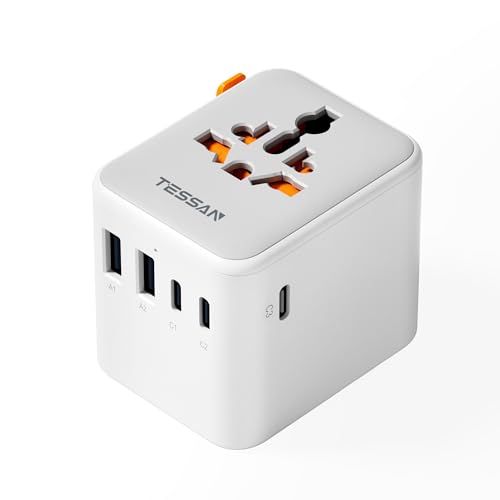
This 6-in-1 travel adapter covers over 150 countries and includes a universal AC outlet plus five USB ports (three USB C ports, two USB A). It supports devices up to 2500W for the AC outlet, making it suitable for simultaneous charging of multiple devices such as phones, tablets and cameras. The unit adapts plug shapes for Type C, G, A, among others, with a front universal outlet that enhances compatibility in varied sockets. A reminder: this is an adapter, not a voltage converter, so high-wattage, non-dual-voltage appliances should not be used without confirmation of voltage compatibility.
decqle Universal Travel Adapter

The decqle adapter claims 4 interchangeable plug types (C, G, A, I) supporting 224+ countries and a 2000W max AC power. It includes 2 USB-C ports (PD 20W max) and 1 USB-A port. It features an intelligent chip to distribute power when multiple devices are connected and a safety design to protect connected devices. This is a true universal adapter designed to handle multiple regions, but it does not convert voltage; ensure devices are compatible with 100-250V input before use, particularly with high-wattage appliances.
200W Step Down Power Voltage Converter Transformer

This 200W step-down transformer converts 220–240V to 110–120V, enabling use of certain UK/european devices in destinations using 110V power. It employs a flame-retardant shell and pure copper winding to improve efficiency and stable voltage conversion. This is a dedicated voltage converter, best for travel stints with high-wattage appliances like certain hairdryers, irons, or travel kettles. Always verify device wattage and compatibility, and remember that not all devices can tolerate voltage shifts or surges; use with caution and follow safety instructions.
Buying Guide
Key considerations when choosing a travel voltage adapter or converter include:
- Voltage vs. power: Adapters do not convert voltage; converters do. If your device is not dual-voltage (100–240V), use a proper voltage converter with wattage capacity matching or exceeding your device’s needs.
- Wattage and amperage: Check the device’s wattage (or amperage at 230V) and ensure the adapter/converter supports it. High-wattage devices like hair dryers or irons require more robust solutions.
- USB port types and power: If you rely on USB charging, verify total USB output and per-port power. USB-C PD ports are beneficial for fast charging laptops and phones.
- Safety features: Look for built-in fuses, surge protection, universal safety shutters, and earth/ground connections where applicable.
- Regional compatibility: Ensure the plug types included match your destinations (EU, UK, US, AU, etc.).
- Size and weight: For frequent travellers, compact designs with light weight reduce luggage burden.
- Device compatibility notes: Read device manufacturer guidance on voltage tolerance to avoid damage.
- Use-case clarity: If you need power conversion for high-power devices, select a converter rather than an adapter with added safety considerations.
In summary, choose adapters when your devices are dual-voltage and require multiple USB charging ports, and reserve step-down converters for devices that do not support 100–240V. For many travellers, a combination approach—an all-in-one adapter plus a dedicated small transformer for a willing high-wattage device—offers flexibility across regions. Always follow the manufacturer’s instructions and, when in doubt, consult device manuals or support resources for voltage requirements.