Finding studs, wires, and pipes behind walls is essential for safe and effective home projects. The following handpicked wall stud finders offer reliable detection and clear displays to help you drill, mount, and secure fixtures with confidence. Below are five top options that balance accuracy, ease of use, and value for UK homeowners and DIY enthusiasts.
| Product | Brand | Key Feature |
|---|---|---|
| FOLAI TH550 5-in-1 | FOLAI | Five scanning modes for wood, metal, live wires, and more |
| aquota 8-in-1 Stud Finder | aquota | Six scan modes plus bubble level and ruler |
| Franklin Sensors ProSensor M70 | Franklin Sensors | Seven sensors for high accuracy; centre and edges |
| Franklin Sensors ProSensor M210 | Franklin Sensors | Thirteen sensors; live wire detection; full stud width |
| The StudBuddy Magnetic Stud Finder | The StudBuddy | No batteries; magnetic nail/screw detection |
This guide focuses on practical features, accuracy, and value, aiming to help UK buyers compare models without getting lost among specs. Each product section below highlights what makes the device suitable for common tasks such as mounting shelves, fixing televisions, or installing cabinets, with material compatibility and detection depth considered where applicable.
FOLAI TH550 5-in-1 Review

The FOLAI TH550 5-in-1 wall scanner is designed to locate metal pipes, fire lines, studs, wooden frames, and bracing behind walls, floors, and ceilings. It uses multiple scanning modes to identify different materials and depth ranges, making it suitable for renovation work where hidden services must be avoided. The device supports depths up to approximately 3 inches for wood and metal components and includes an auto-calibration function for improved reliability. An ergonomic grip helps operators maintain steady contact during scanning, and the unit is intended for both professionals and DIY enthusiasts who want a versatile detector that reduces drilling mistakes.
Its five scanning modes cover metal tubes, fire lines, studs, wooden frames, and brackets, plus ceilings. The unit can detect live voltage up to about 2 inches, allowing safe drilling near electrical runs. Calibration is automatic after a brief hold of the scan button, which helps ensure readings are consistent across uses. While performance can vary with wall material and thickness, the TH550 provides a good balance of speed, accuracy, and user comfort for typical UK housing construction.
aquota 8-in-1 Stud Finder Details
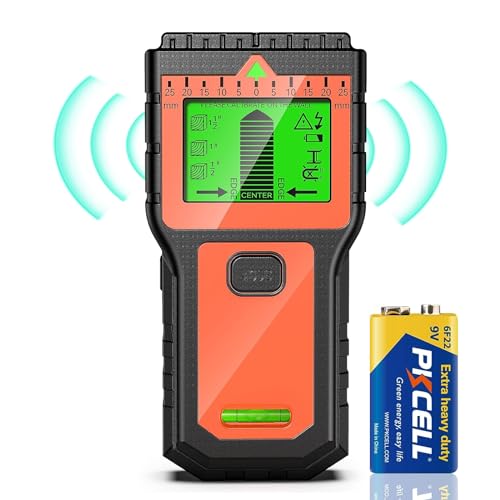
The aquota 8-in-1 wall scanner combines several essential functions into a single device. It offers multiple scan modes for studs, metals, and live wires behind walls, with an integrated bubble level and ruler to help ensure measurements stay accurate throughout a project. The unit emphasizes automatic calibration and a clean, intuitive interface, designed to minimize user errors when locating centers and edges of studs. This makes it suitable for mounting shelves, TVs, or other fixtures where precision matters and wall materials vary. The device aims to deliver reliable performance with straightforward operation, appealing to both DIYers and professional tradespeople.
Key benefits include accurate detection of live AC wires, reinforced by audible alerts and a stable display. The integrated level helps ensure straight mounting lines, reducing the risk of misalignment. For users curious about depth, this model typically handles common UK wall constructions well, though very dense masonry may affect performance. Overall, the aquota offers a practical, compact option for daily hanging tasks with multiple functions in one tool.
ProSensor M70: Centre And Edges

The Franklin Sensors ProSensor M70 is designed to maximise accuracy with seven sensors. This configuration guides users to the center and edges of each stud, enabling precise anchoring for hardware that requires exact alignment. A notable feature is its ability to detect wood and metal studs behind drywall, with a depth capability around 1.5 inches. The one-mode approach aims to simplify scanning, reducing calibration steps and providing quick results in everyday projects. The LED indicators clearly mark the detected area, which aids in planning screw placement or mounting brackets without guesswork.
When working through common wall materials, the M70’s seven-sensor array helps mitigate common errors associated with single-sensor devices. It’s well-suited for installing mid-size shelving, framed mirror hangings, and other fixtures where accurate stud location is critical. While it won’t replace deep masonry detection, it offers a reliable, user-friendly option for standard UK interior walls and typical drywall configurations.
ProSensor M210: More Sensors, More Confidence
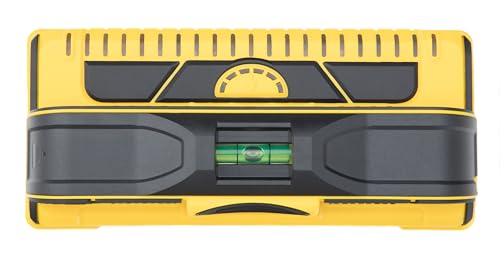
The Franklin Sensors ProSensor M210 expands detection to 13 sensors, delivering high-precision locating across drywall and similar surfaces. It provides a live wire detection feature, enabling safer drilling by identifying electrical cables before you drill. The device displays the full width of studs, showing both the center and edges simultaneously, which can be particularly helpful when aligning multiple fasteners or mounting wide fixtures. The M210’s readout and audio cues guide users to the exact stud location, reducing the risk of drilling into pipes or electrical wires behind walls.
With its enhanced sensor array, the M210 is appropriate for complex installations and projects that demand extra assurance. It’s capable of identifying single studs, double studs, and wider framing, making it versatile for shelves, cabinets, and wall-mounted décor. The combination of safe live-wire detection and comprehensive stud width display helps users plan layouts with greater confidence, especially on older UK walls with varied framing behind plaster and drywall.
The StudBuddy Magnetic Finder

The StudBuddy is a magnetic stud finder that eliminates the need for batteries. It works by locating nails or screws inside wood studs behind drywall, offering a simple, immediate signal when a stud is found. This makes it an attractive option for quick projects or for those who prefer a straightforward approach to locating studs without electronic components. While it may not provide the depth sensing of electronic scanners, its simplicity and reliability for standard wall mounting tasks can be a practical choice for basic assignments such as hanging lightweight frames or picture hooks.
In addition to being battery-free, the StudBuddy can remain mounted or stored on the wall when not in use, serving as a handy reminder of stud locations. It is best suited for lighter loads and shorter installations where the fastest possible locating method is advantageous. For heavier mounting or more detailed layouts, pairing the StudBuddy with a digital scanner can improve placement accuracy.
Buying Guide: Key Purchase Considerations
- Detection capabilities: Choose a model that matches your typical tasks. If you frequently install heavy shelves or TVs, consider devices with multiple sensors and live wire detection.
- Depth and material coverage: Look for depth specs compatible with your walls (drywall, masonry, plaster). More sensors generally improve accuracy on complex substrates.
- Calibration and ease of use: Auto-calibration reduces setup time. Ergonomic designs help during extended scanning sessions.
- Display and alerts: A clear LED or LCD readout plus audible alerts aids quick interpretation, especially in dim workspaces.
- Additional features: Bubble levels, rulers, and edge/center markers can streamline alignment and mounting tasks.
- Power and reliability: For frequent use, consider models with proven battery management or battery-free options for convenience.
- UK compatibility: Ensure the device is suitable for common UK wall constructions, including plaster, drywall, and timber framing.
- Safety considerations: Live wire detection is essential to avoid drilling into electrical cables; always drill away from detected zones.